
Jersey barriers are the modular you may see lining highways, medians, or construction sites. Their unique name comes from the US state of New Jersey, which started widely using them to divide lanes of traffic in the 1950’s. Unlike other standard barriers, these sturdy structures are specifically designed to deflect vehicles and prevent them from crossing into other lanes where they could strike other vehicles or pedestrians.
But how does this deflection work, exactly - How does a jersey barrier’s design deflect vehicles?
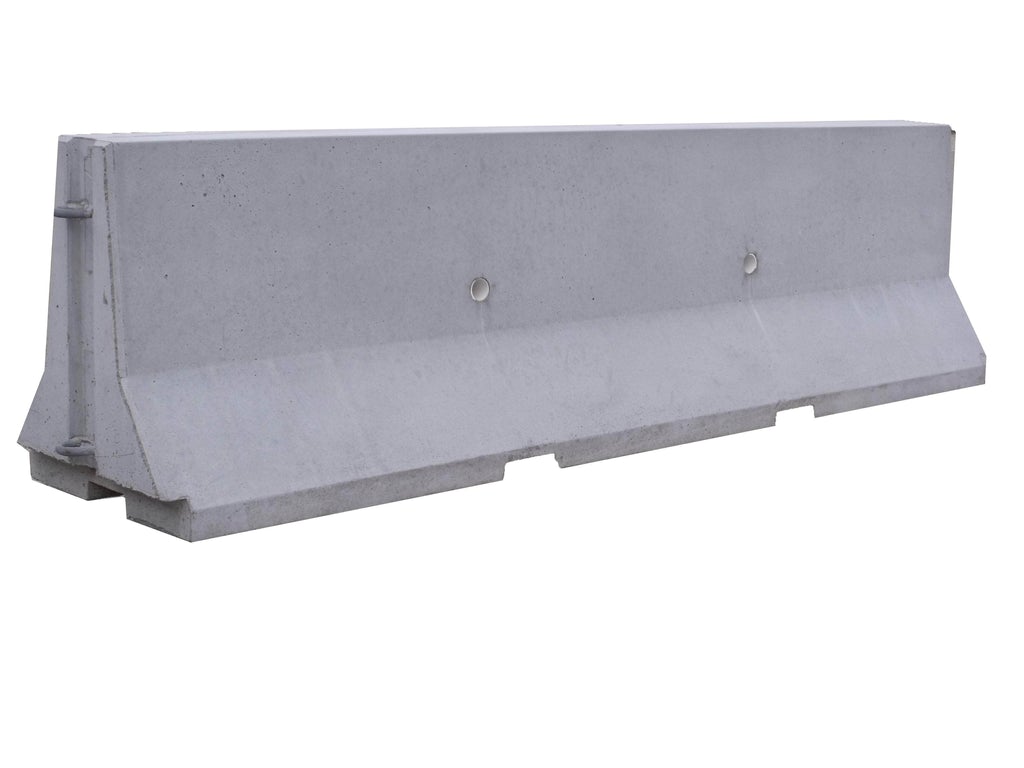
In the image above you can see a typical concrete safety barrier like those for sale from most crowd control and traffic safety suppliers. The basic structure of a concrete jersey barrier is around ~32 inches high and includes two slopes. The lower slope has a sharper angle, and the upper slope is much more slight. Each serves a slightly different purpose and contributes to vehicle deflection, as outlined in this article by the US Department of Transportation.
How Jersey Barriers Deflect Vehicles
Imagine a distracted driver who may be slightly drifting towards another lane of traffic, but at a fairly slight angle. When a vehicle comes into contact with a standard jersey barrier at a fairly shallow angle like this, (which is most common), the lower slope is designed to allow the tire to ride up the slope face, minimizing the likelihood of sheet metal contact and damage. This prevents the vehicle from crossing into another lane of traffic, but with a minimal amount of damage to the vehicle itself.
When the angle of impact is sharper, however, the upper slope comes into play. For instance, imagine a driver who is reacting to something in the road and actually turns their wheel into the opposite lane of traffic, giving them a sharper angle of impact when they hit the jersey barrier. In this case, the upper slope is designed to lift the bumper up its slope face upon impact until the tire can engage with the lower slope and ride up the lower slope face as it did in the first example. Depending on the bumper strength, this may cause damage to the front bumper, but should achieve the same deflection which prevents full force contact of the sheet metal, or full force interruption of the opposite lane of traffic.
The slopes of a jersey barrier and the lift which they cause to a vehicle on impact is effective in part because it reduces the friction of the tire on the pavement. This prevents the vehicle from uncontrollably pitching, rolling, etc.
However, if the slope's breakpoint is too high, the car can be caused to roll over. For instance in the 1970’s, General Motors had a barrier shape which caused some small cars to lift too much. Again, too much of a lift can cause the vehicle to roll.
With larger vehicles, there is yet another function of the barrier design. As long as the jersey barrier is tall enough, (32 inches for box-truck sizes and 42 inches for 18-wheelers), the top of the barrier sustains a large vehicle sliding along it until it can be redirected upright again. While this may sound more dramatic than the small vehicle’s simple deflection, in crash tests it prevents these large vehicles from fully crossing or rolling into the opposite lane of traffic.
How do plastic, water-filled jersey barriers work?
Not all jersey barriers are made with concrete, though this is certainly the most effective and truly impact-resistant option. In cases where a temporary or moveable barrier is needed, concrete can be impractical. (For instance when construction requires the temporary creation of new lanes, but these lanes need to be removed once construction is over, concrete is best thought of as a permanent barrier and may not be practical.)
In temporary situations like these, plastic, water-filled jersey barriers are common alternatives. In this post, we compare plastic jersey barriers vs concrete jersey barriers. In essence, plastic, water-filled barriers have the same shape and design as a concrete barrier, but they are made of impact-resistant plastic which can be filled with water or sand to add weight and stability. While this does add considerable weight, these barricades are not truly crash-resistant. The double slope shape still allows tire lift, however.
Conclusion
Throughout the year's other barrier shapes have been trial-ed and some are even more effective than the traditional Jersey barrier. However, the traditional jersey barrier adequately meets crash resistant requirements and has been widely adopted for this reason. Learn more about both plastic and concrete jersey barriers here.


